
Nvidia's co-founder resigned after admitting to infidelity that he himself linked to national-security concerns. The case shows how the US-China contest over AI chips is played: the board, the pieces, the documented moves, and what each side stands to gain or lose.
Published 12 November 2026. Developing story: updates will be added under "What is happening now", newest first.
What happened
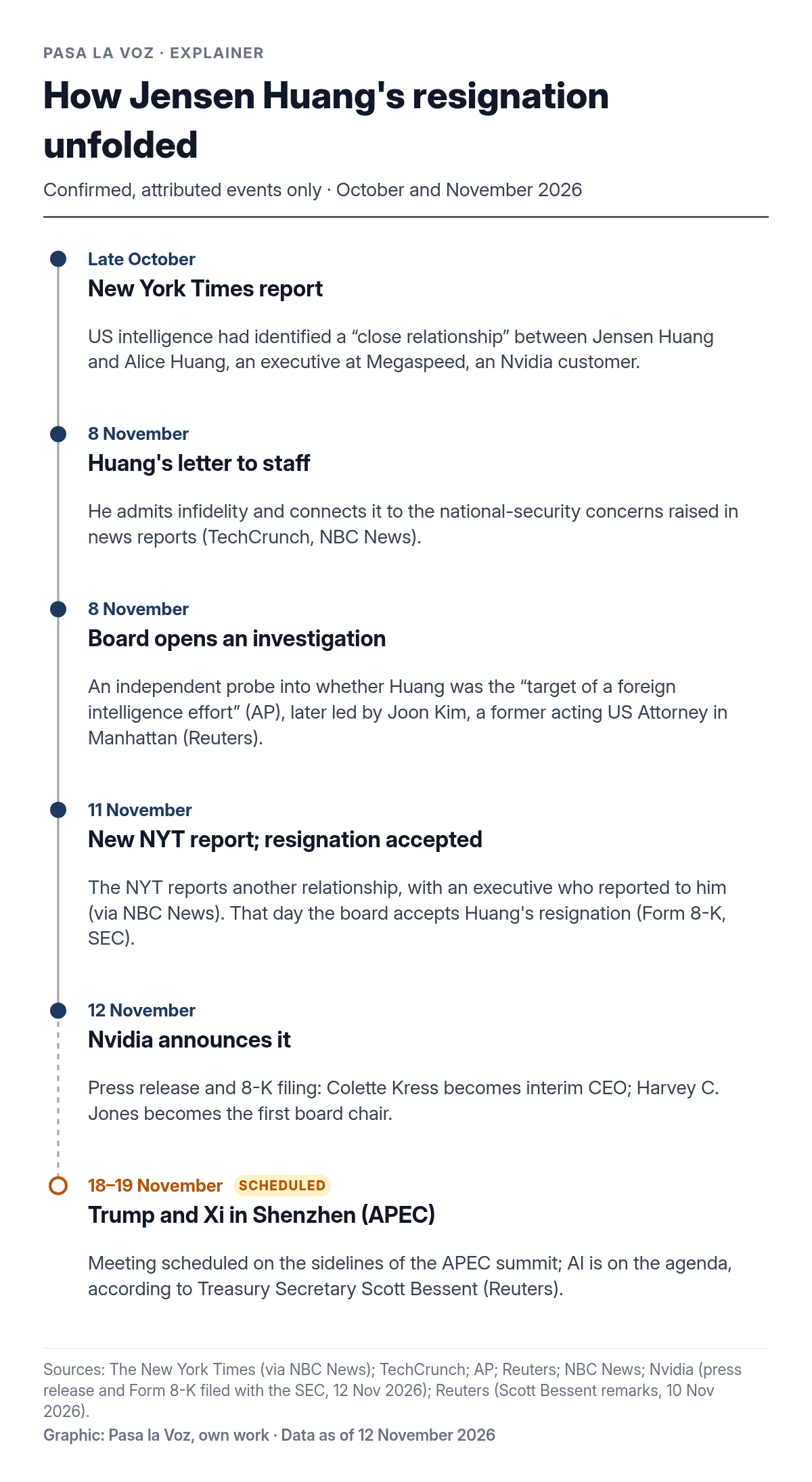
In late October, The New York Times reported that US intelligence had identified a "close relationship" between Jensen Huang and Alice Huang (no relation), an executive at Megaspeed, a Singapore-based cloud computing company and Nvidia customer. According to NBC News, which confirmed it with two sources, a memo overseen by Secretary of State Marco Rubio had stated this spring that US intelligence regarded her as an asset of China's spy service. Her exact role is unclear, and China rejects the accusations as "groundless" (Reuters). On the evening of 12 November, Attorney General Todd Blanche said the Justice Department had not reached a conclusion on whether she was a Chinese spy, and Trump said he did not know if that had been determined yet (Reuters). According to CNN, US officials are divided and the intelligence collected to date does not prove she was acting as a spy for Beijing.
On 8 November, Huang admitted in a letter to staff that he had been unfaithful to his wife and connected it to "the national security concerns raised in news reports". The same day, the board opened an independent investigation into whether he had been the "target of a foreign intelligence effort" (AP), later retaining Joon Kim, a former acting US Attorney in Manhattan, to lead it (Reuters). The board says it has no reason to believe national security or company secrets were compromised.
On 11 November, The New York Times reported another relationship, with an executive who reported directly to Huang, which NBC News said appears to run afoul of Nvidia's code of conduct. That day, according to Nvidia's filing with the Securities and Exchange Commission, the board accepted his resignation as president, CEO and director. Nvidia announced it on 12 November: chief financial officer Colette Kress is interim CEO, and Harvey C. Jones, a director since 1993, becomes the company's first board chair.
The board: chips as a strategic resource
Nvidia's processors underpin many of the AI applications that have powered the stock market and economic growth, and it is the world's second-largest listed company (NBC News). That is why Washington restricts sales of its most powerful chips to China. According to the think tank CNAS, the policy, begun in Donald Trump's first term and stepped up under Joe Biden, aims to stop China buying or making the chips needed to train the most advanced AI.
The pieces
- Companies: Nvidia and its customers. Megaspeed rented computing power to Alibaba and other Chinese firms, according to The New York Times as cited by TechCrunch, and is under US criminal investigation over alleged chip smuggling (NBC News). Nvidia and Megaspeed deny wrongdoing (The Guardian).
- Key executives: Huang had about 60 direct reports and no known successor, and had repeatedly argued for selling more in China (TechCrunch).
- Intelligence services: according to The Guardian, the US conclusion about Alice Huang rests on surveillance whose details remain classified.
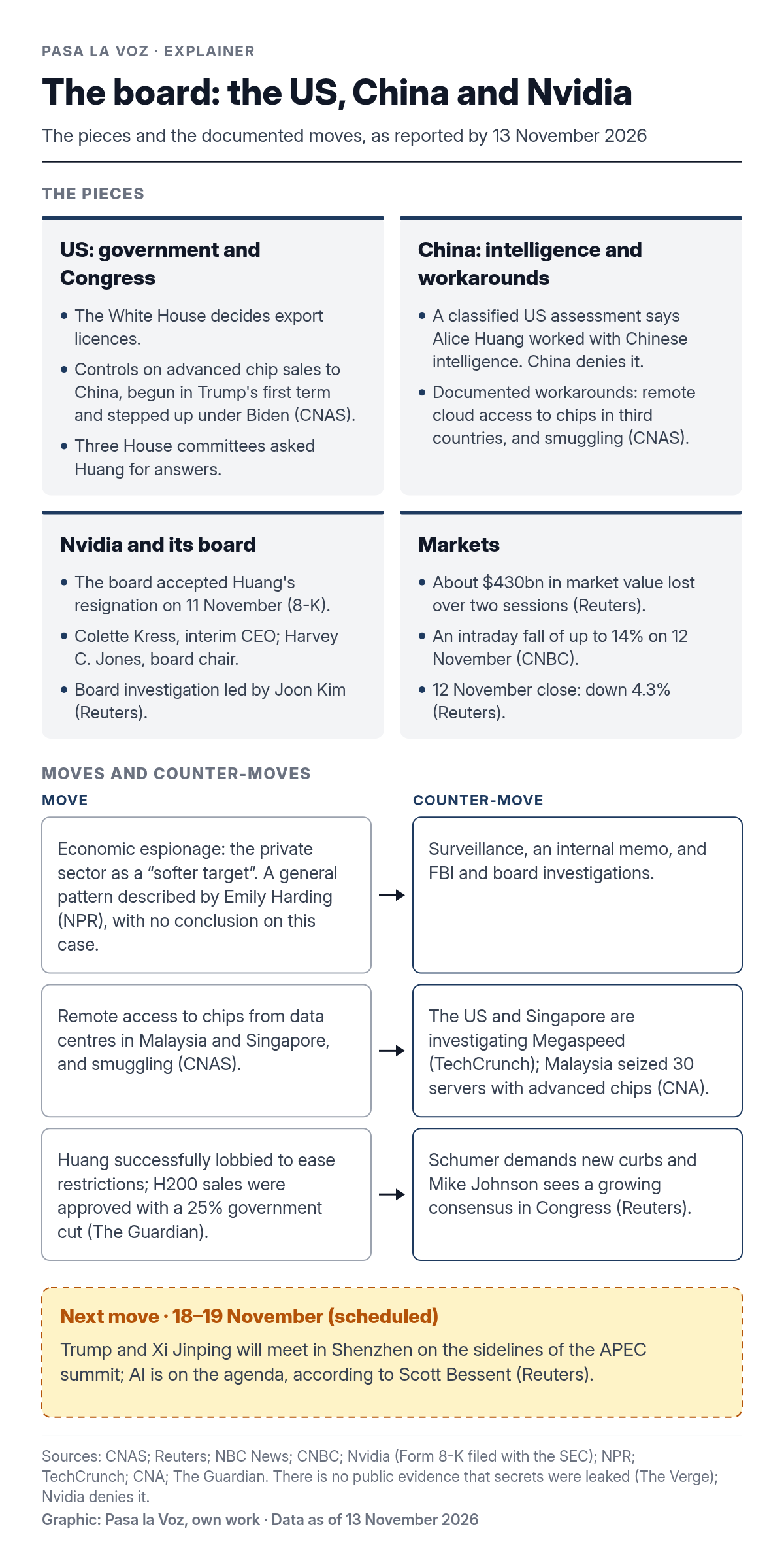
- Governments and Congress: the White House, which decides export licences, and three House committees that asked Huang for answers over China's possible access to "sensitive U.S. technology and information".
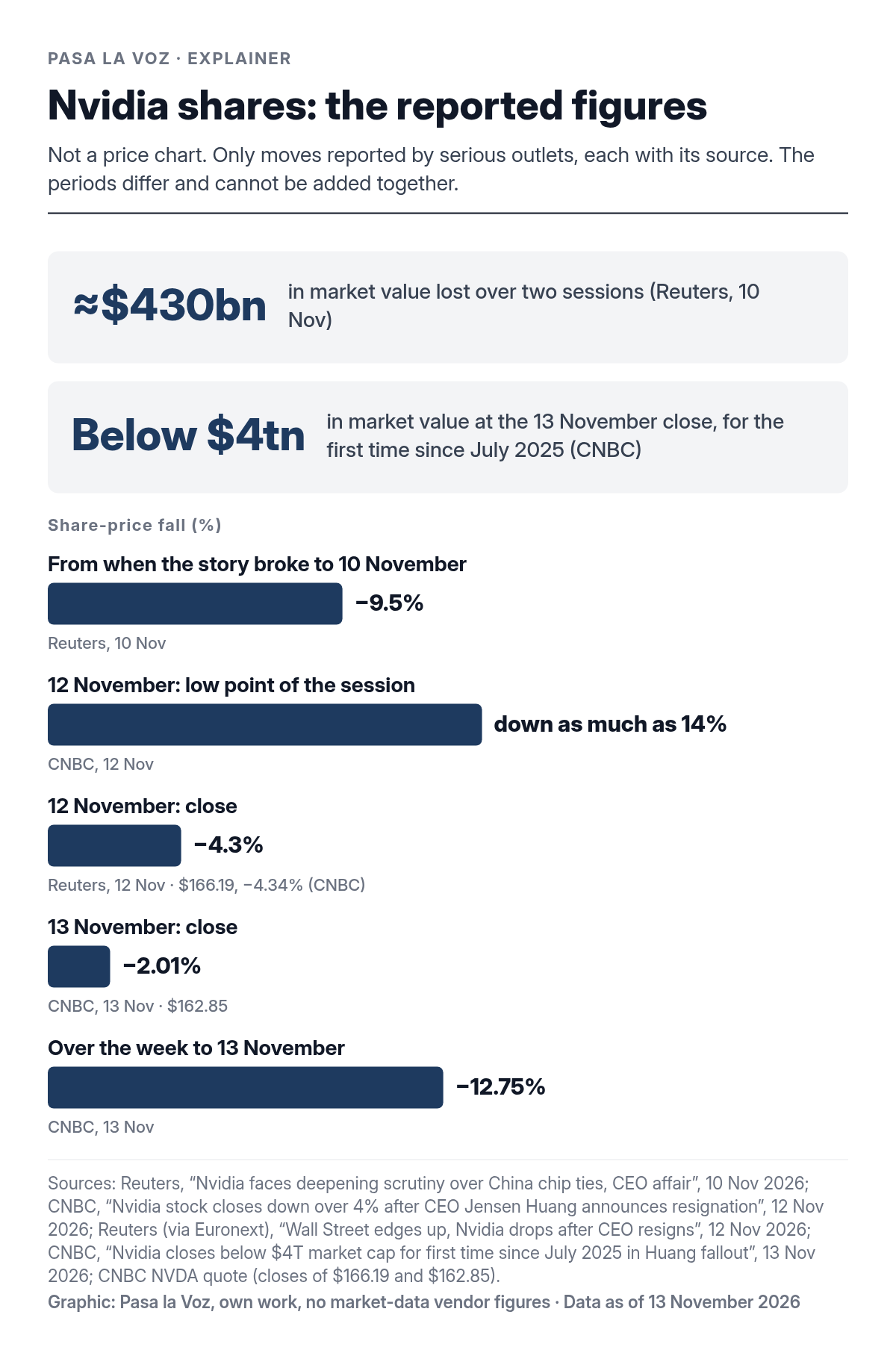
- Markets: Nvidia lost about $430bn in value over two sessions (Reuters) and on 12 November fell as much as 14% in the session (CNBC) before closing down 4.3% (Reuters).
Moves and counter-moves
Intelligence versus counterintelligence. Emily Harding, a former CIA analyst now at CSIS, told NPR that China has long leaned into economic espionage because the private sector is a "softer target", though she cautioned that too little is known about this case to judge it. The US counter-moves are on record: surveillance, an internal memo and now FBI and board investigations. What was done with that warning is disputed. According to The New York Times, Rubio briefed Trump in May aboard Air Force One en route to China, shortly before Huang joined the trip; it was at least the second time in seven months the president had been told. Trump had said on 9 November: "No, I didn't hear about it then." The White House disputed the Times report without elaborating and pointed to the president's remarks (The New York Times, Reuters).
Controls versus workarounds. CNAS documents that controls stopped the legal import of advanced chips but not remote access from data centres in countries such as Malaysia and Singapore, nor smuggling networks. Counter-moves are visible too: the US and Singapore have investigated Megaspeed since October 2025 (TechCrunch); Singapore police are investigating it over possible breaches of local law; and in October Malaysian customs seized 30 servers containing advanced chips worth about $12.1m (CNA).
The next move. Trump will meet Xi Jinping in Shenzhen, on the sidelines of the 18–19 November APEC summit; it will be their third meeting this year and AI is on the agenda, according to Treasury Secretary Scott Bessent (Reuters). Trump said on 9 November that Huang will not accompany him and that he does not plan to raise the matter with Xi (The New York Times).
How this could benefit China
There is no public evidence that secrets were leaked (The Verge), and Nvidia says none were. With that caveat, the documented record points to three possible advantages:
- Proximity to power: Huang had a close relationship with Trump and successfully lobbied to ease restrictions on chip sales to China, including approval of H200 sales in exchange for a 25% government cut (The Guardian). If the US intelligence assessment is right, that is valuable to a rival.
- Access to computing: the third-country cloud loophole described by CNAS, in which Megaspeed operated.
- A rival in disarray: the key company of American AI loses its founder with no designated successor and several investigations under way.
But the move may prove costly: the scandal has handed ammunition to those calling for tighter controls. Senate Democratic leader Chuck Schumer is demanding new curbs on chip exports (Reuters).
How the US can respond
Some responses are already under way; others are on the table:
- Under way: the board investigation, the FBI review, the criminal investigation into Megaspeed and the closed-door interview three House committees have requested from Huang for 1 December, and the Senate Banking Committee hearings (Huang invited for 3 December; Lutnick on 10 December).
- CNAS proposals: pass the Remote Access Security Act, a bipartisan bill to close the cloud loophole; give Congress more power to block sensitive sales (the AI Overwatch Act); strengthen the Bureau of Industry and Security (BIS), which polices exports; add Megaspeed to the Entity List; and step up counterintelligence briefings for tech executives.
Not giving away pieces matters too. Quoting a post by investor Shaun Maguire on Huang's contributions, Eric Weinstein wrote on X: "More simply: we are meme-ing ourselves in the foot while our rivals laugh over cigars and champagne." That is an opinion. Republican Senator Kevin Cramer voiced the opposite view: the potential for extortion was "so tremendous" that Huang had to go (Reuters).
"More simply: we are meme-ing ourselves in the foot while our rivals laugh over cigars and champagne."
Why it matters to you
- Nvidia's chips sit behind many everyday AI tools.
- It is the world's second-largest listed company: its shocks are felt in markets.
- The game is also played outside the US and China, in Southeast Asian data centres and customs posts.
What is happening now
13 November 2026
Treasury Secretary Scott Bessent says Treasury, Defense, the US Trade Representative and the State Department had for months favoured adding Megaspeed to the Entity List, but "Commerce has the pen" (CNBC, via BBC). Commerce Secretary Howard Lutnick has agreed to appear before the Senate Banking Committee on 10 December; the committee's chair, Tim Scott, has asked Huang to testify on 3 December and has not ruled out a subpoena (NBC News, Reuters). Three House committees have asked Huang for a closed-door transcribed interview on 1 December, or he will face a subpoena (Reuters). Chinese foreign ministry spokesperson Mao Ning reiterated Beijing's opposition to the "abuse of export control measures" (Chinese Ministry of Foreign Affairs). Malaysia is investigating whether SpeedMatrix, a Megaspeed subsidiary, re-exported AI chips, and says it has never cleared those companies (MITI statement). Nvidia shares closed on 13 November down 2.01% at $162.85, leaving its market value below $4 trillion for the first time since July 2025; the stock fell 12.75% over the week (CNBC).
12 November 2026
Nvidia announces Huang's resignation with immediate effect and files the change with the SEC. Republican Brian Mast, chair of the House Foreign Affairs Committee, says Huang is willing to testify as soon as next week and does not rule out a subpoena (CNBC). House Democratic leader Hakeem Jeffries calls for a classified briefing. Nvidia shares finished 4.3% lower, off the day's lows (Reuters); CNBC put the close at 4.34%, or $166.19, after an intraday fall of as much as 14%. Trump and Xi Jinping will meet next week in Shenzhen (Reuters). House Speaker Mike Johnson says the growing consensus in Congress favours new restrictions on chip exports to China (Reuters). Nvidia still reports quarterly results on 17 November.
Sources
- NVIDIA (press release) — "NVIDIA Announces CEO Transition" — 12 Nov 2026
- NVIDIA (Form 8-K filed with the SEC) — "Current Report, Item 5.02" — 12 Nov 2026
- NBC News — "Nvidia CEO Jensen Huang resigns after affair with suspected Chinese spy" — 12 Nov 2026
- TechCrunch — "The unfolding Jensen Huang scandal: a timeline" — 12 Nov 2026
- AP — "Nvidia investigates whether CEO Jensen Huang was targeted by Chinese spy with whom he had an affair" — 8 Nov 2026
- Reuters — "Nvidia faces deepening scrutiny over China chip ties, CEO affair" — 10 Nov 2026 (updated 11 Nov)
- The New York Times (via The Philadelphia Inquirer) — "Despite denial, Trump was told on trip to China about spying on Nvidia leader" — 10 Nov 2026
- Reuters (via Euronext) — "Wall Street edges up, Nvidia drops after CEO resigns" — 12 Nov 2026
- Reuters — "US and China should stay clear-eyed on AI cooperation and competition, Bessent says" — 10 Nov 2026 (updated 11 Nov)
- Reuters (via U.S. News & World Report) — "Explainer-Tougher Curbs on AI Chip Sales to China Likely After Nvidia CEO Resigns" — 12 Nov 2026
- CNBC — "Nvidia CEO Jensen Huang resigns: Live updates" — 12 Nov 2026
- NPR — "Steve Inskeep talks to ex-CIA analyst about alleged Nvidia Chinese spy case" — 11 Nov 2026
- The Guardian — "Thursday briefing: What we do (and don't) know about Alice Huang and the Nvidia affair" — 12 Nov 2026
- The Verge — "The US is winning the AI race. Jensen Huang could have blown it" — 10 Nov 2026
- CNAS — "The Nvidia Scandal Is a Wake-Up Call for Congress" (Emily Kilcrease and Vivek Chilukuri) — 12 Nov 2026
- CNA — "Jensen Huang scandal could spur tighter US scrutiny of AI cloud providers in Southeast Asia: Analysts" — 11 Nov 2026
- Eric Weinstein (X) — post — 12 Nov 2026
- Shaun Maguire (X) — post quoted by Weinstein — 12 Nov 2026
- CNBC — "Nvidia closes below $4T market cap for first time since July 2025 in Huang fallout" — 13 Nov 2026 (quote: https://www.cnbc.com/quotes/NVDA)
- BBC — Bessent and Megaspeed — 13 Nov 2026; also Reuters (via Investing.com): https://www.investing.com/news/economy-news/bessent-says-treasury-favored-limits-on-megaspeed-5025721 and AP: https://apnews.com/article/nvidia-megaspeed-scott-bessent-howard-lutnick-17582a5098a5fb4c8fe866a084a6e52b
- Reuters (via Investing.com) — Senate Banking Committee asks Huang and Lutnick to testify — 12–13 Nov 2026
- NBC News — Lutnick agrees to testify — 13 Nov 2026
- House Foreign Affairs Committee (press release) — second request to Huang and Nvidia
- Chinese Ministry of Foreign Affairs — 13 Nov 2026 press conference
- Malaysia's MITI (statement) — 13 Nov 2026 — https://www.miti.gov.my/miti/resources/Speech/MEDIA_STATEMENT_13112026.pdf; CNA: https://www.channelnewsasia.com/asia/malaysia-probe-megaspeed-speedmatrix-ai-alice-huang-nvidia-6548491
- Reuters (via Investing.com) — Blanche: Justice Department has not concluded Alice Huang was a spy — 12 Nov 2026
- CNN (via KVIA, CNN Newsource) — 12 Nov 2026 — https://kvia.com/politics/cnn-us-politics/2026/11/12/us-intel-isnt-sure-if-businesswoman-spied-on-nvidia-for-china-doesnt-mean-she-wasnt-a-risk-sources-say/; CNN in Spanish: https://cnnespanol.cnn.com/2026/11/12/eeuu/inteligencia-espionaje-alice-huang-nvidia-china-trax