
Between Thursday afternoon, 12 November, and Saturday morning, 14 November 2026, millions of people around the world could not use Outlook work email, Teams, Copilot and other Microsoft 365 tools normally. The problem lasted more than 24 hours, was reported in more than 70 countries and hit hospitals, courts, governments, banks and airlines, according to Reuters, AP and the BBC.
Published 14 November 2026.
Microsoft says it was not a cyberattack or a failure caused by artificial intelligence, but a technical problem introduced during an earlier upgrade of its network. The company has apologised and promised a full report, which it has not yet published.
Here we explain, step by step and in plain language, what happened.
In brief
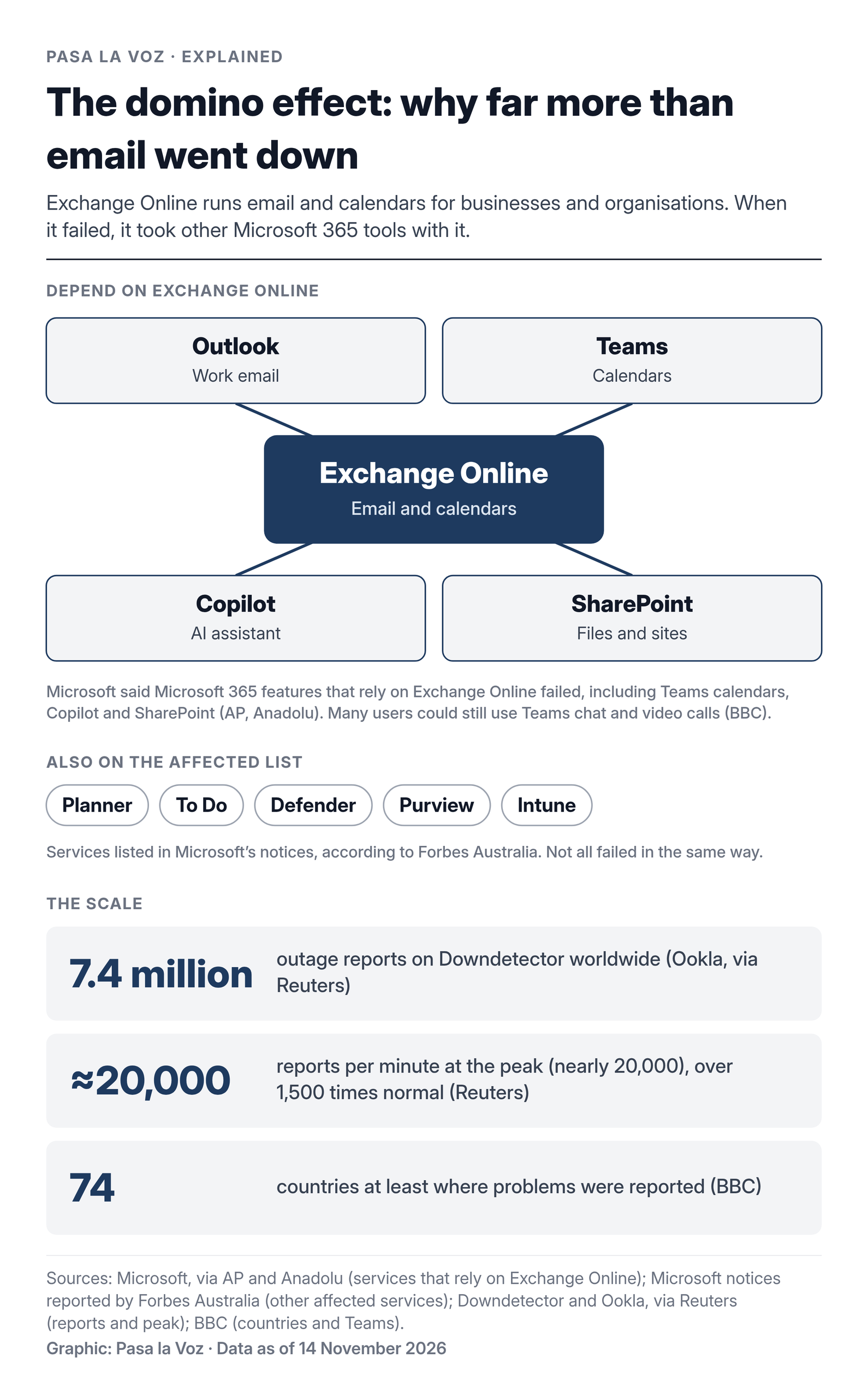
- What failed: Exchange Online, the Microsoft system that runs email and calendars for businesses and organisations. When it went down, it took with it other tools that depend on it, such as Teams calendars, Copilot and SharePoint.
- How long it lasted: more than 24 hours of serious disruption. Microsoft posted its first notice on Thursday 12 at 17:54 (UTC) and did not announce that service had been restored for all customers until Saturday 14 at 06:09 (UTC).
- Why, according to Microsoft: an issue introduced during an earlier upgrade of its network capacity, which surfaced after a recent change to that network.
- What it wasn't: Microsoft says there is no sign of a cyberattack or malicious activity, and that artificial intelligence played no part either.
- What's still missing: Microsoft's full technical report, which the company has promised but not yet published.
First, two concepts
The cloud. Microsoft 365 is Microsoft's suite of office tools (Outlook, Teams, Word, Excel, SharePoint, Copilot…). It works "in the cloud": your emails, files and calendars are not only on your computer or phone, but in huge Microsoft data centres that you connect to over the internet. If those servers fail, it doesn't matter that your computer works perfectly: you can't get to your data.
Exchange Online. This is the part of Microsoft 365 that handles email and calendars for organisations that use Outlook. Many other features rely on it, which is why, when it failed, Teams calendars, Copilot and SharePoint also stopped working properly, as Microsoft explained. Applications that do not depend on Exchange Online kept working, Reuters reports.
What happened, step by step
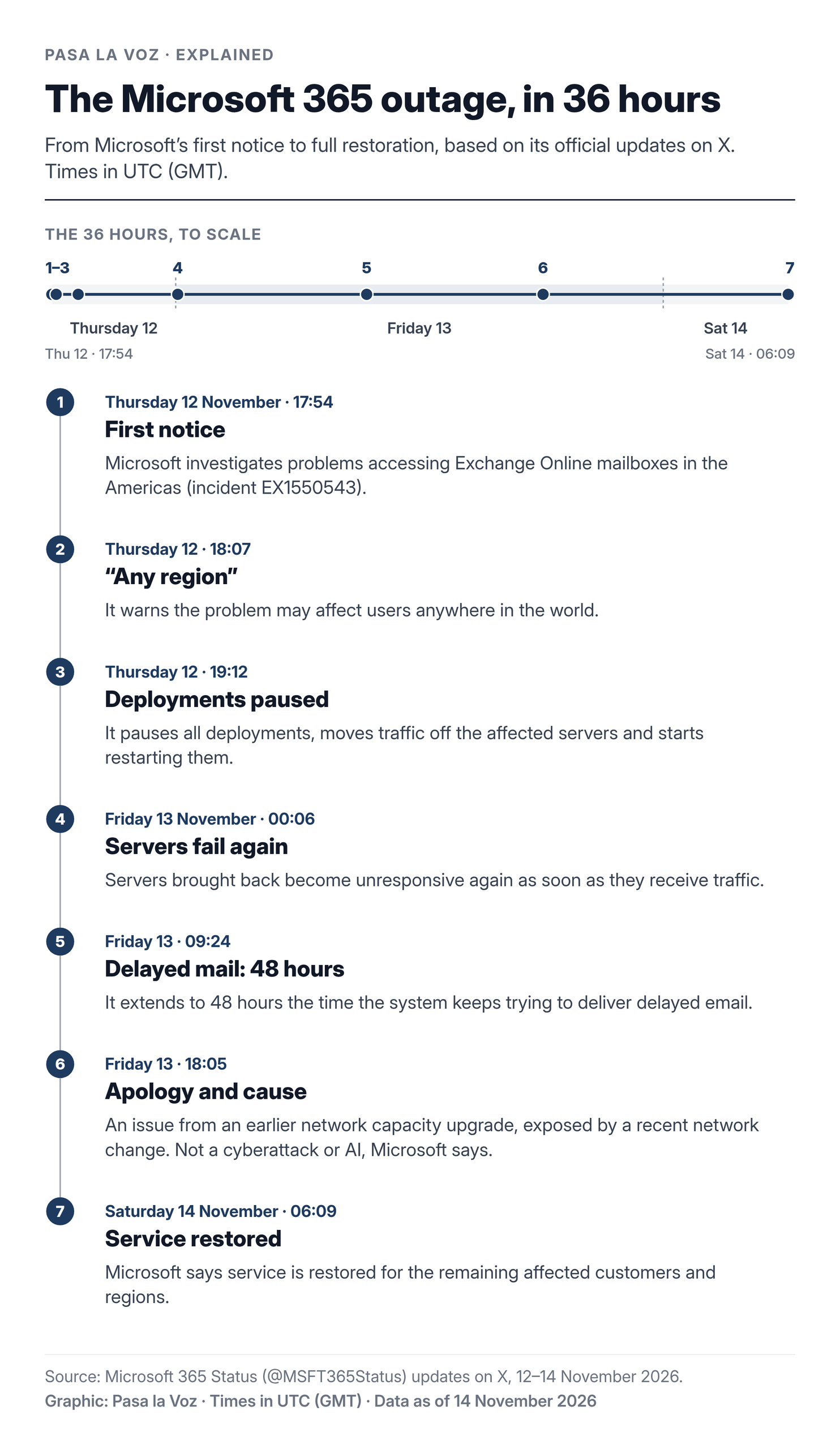
This timeline is based mainly on the updates posted by the official Microsoft 365 Status account (@MSFT365Status) on X. Times in UTC.
Thursday 12 November 2026
- Around 17:25 — Outage reports start to soar on Downdetector, the website where users report problems, according to its parent company, Ookla (Reuters).
- 17:54 — Microsoft confirms it is investigating problems accessing Exchange Online mailboxes in the Americas. It opens incident EX1550543.
- 18:07 — It widens the warning: the problem may affect users in any region of the world.
- 18:35 and 18:48 — It detects "elevated load" on part of its infrastructure across several regions and starts redistributing traffic across the rest of its worldwide network.
- 19:12 — It pauses all deployments (in other words, it halts any updates in progress), moves traffic off the affected machines and starts restarting servers.
- 19:31 — It clarifies that traffic is not higher than normal: the problem is that a number of servers have unexpectedly become unavailable and the remaining ones are overloaded.
- 19:50 and 20:19 — It explains that servers are failing automated "health checks" (the tests the system uses to decide whether a server is fit to work) and that the fault may come from the component that processes those checks. At this point it says it has found no recent change that coincides with the start of the problem.
- 21:00 — An alternative health-check method allows some of the servers to return to service.
- 21:40 — It considers reverting some recent configuration changes in case that speeds up recovery.
- 22:09 — It admits that its actions so far "have not provided the anticipated relief" and that a core process on the affected servers is becoming overwhelmed.
- 23:04 — Some of the servers are back in service and remain stable.
Friday 13 November 2026
- 00:06 — Setback: the recovered servers become unresponsive again as soon as they receive traffic. Microsoft limits which types of traffic can reach them and rebuilds some with a previous configuration to see whether they then hold up.
- 01:59 — Restarting machines in stages, in isolation, starts to show "positive results".
- 03:13 — It admits the changes applied are "not taking as expected" and looks for other ways to add capacity.
- 04:36 — It adjusts, redistributes and blocks some traffic. There is partial recovery in some regions, but it is not yet sustained.
- 07:44 — The latest traffic measures show "positive results" for stability and capacity, and start to be rolled out in more regions.
- 09:24 — So that delayed emails are not lost, Microsoft extends to 48 hours the time the system keeps trying to deliver them.
- 13:32 — Broad improvement in North America, sustained improvement across much of Europe and "encouraging recovery signals" in Asia Pacific.
- 14:17 — Queues of pending email are "approaching normal levels", although some users still have intermittent problems.
- 15:39 — Microsoft says there is no indication of malicious activity or a cyberattack.
- 18:05 — It apologises publicly and gives its explanation of the cause (see below).
- 20:05 — Still no date for full recovery: it warns that access may return before email flows normally.
- 21:55 — It says it will keep monitoring for an extended period and will check that all the backlogged email is processed before considering the issue resolved.
Saturday 14 November 2026
- 06:09 — Microsoft announces that it has finished addressing the underlying issue and has restored service to the customers and regions that were still affected.
Why it happened
Microsoft's official explanation, published on Friday 13, is this: "This was a technical issue not related to cyber or AI / agents. The incident was introduced by an issue during an earlier network capacity upgrade that surfaced following a recent network change."
Put simply: at some earlier point, Microsoft expanded its network so it could handle more traffic. That upgrade left a hidden fault that did not show itself until another change was later made to the network. Microsoft has not yet explained exactly what the fault was or which change exposed it.
What it did say during the crisis helps explain the domino effect. Many servers began failing the automated checks that decide whether a server is healthy, and the system took them out of service one after another. All the work then fell on the ones left, which ended up overloaded. Microsoft stressed that there were no more users than normal: there were fewer servers to serve them.
It's like a supermarket at rush hour where half the tills suddenly close: the queues move to the open tills, which are overwhelmed. And when a till tries to reopen, everyone waiting rushes to it and it seizes up again. That, in essence, is what Microsoft described in the early hours of Friday: the servers it brought back became unresponsive again as soon as they received traffic.
Professor James Ferryman, of the University of Reading's department of computer science, summed it up for the BBC based on what Microsoft had disclosed: the part of the servers that sets up secure connections gets swamped and the server stops answering; its work passes to the next one, while huge numbers of phones and laptops keep trying to reconnect. "You can't just turn it all back on at once. You have to bring it back bit by bit," he said.
That is why it took so long. Microsoft itself acknowledged it: "Given the scale of demand, we restored services gradually, validating stability at each stage. While this took longer, it helped ensure a stable restoration."
One important detail: on Thursday evening Microsoft said it had found no recent change that coincided with the start of the problem; the next day it attributed the cause to the network upgrade and a later change. The company has not explained how the two fit together. We will have to wait for its full report.
Who was affected
Mainly businesses, public bodies and organisations that use Microsoft 365 for work email. Many users could not send or receive emails, open some files or see their calendars; others, however, could still use Teams chat and video calls without problems, according to the BBC. Organisations that run Microsoft's services on their own servers, rather than in the cloud, were partly spared (Reuters).
The scale
- Downdetector logged more than 7.4 million outage reports worldwide, peaking at nearly 20,000 a minute, more than 1,500 times normal levels (Ookla, cited by Reuters).
- Users reported problems in at least 74 countries, according to the BBC, and in more than 70 countries and territories, according to AP.
- Microsoft says on its website that more than 430 million people use Microsoft 365 apps, but the actual number affected has not been confirmed (BBC).
- Reports spiked as the working day began in Asia and Europe (Ookla, cited by Reuters).
Services affected
Besides Outlook email, the list of affected services compiled by Forbes Australia from Microsoft's notices includes Teams, SharePoint, Microsoft 365 Copilot, Planner, To Do, the Defender security tools, Purview (data protection), Intune (management of company laptops and phones), some Power BI features and the Universal Print printing service. Not all of them failed in the same way: in many cases only the features that depend on email failed.
Some real examples
- Health. In the UK, the NHS was badly affected: some staff had to fall back on paper records (DW, Reuters). Some GP surgeries asked patients not to send messages through their websites (BBC). In Canada, a network of Toronto hospitals had email problems, although patient care was not affected (CBC, cited by the BBC).
- Police and courts. London's Metropolitan Police could not take some crime reports online, although it was still answering calls (Reuters). Courts from Los Angeles to Texas warned of delays in their communications (BBC).
- Governments. Japan's government reported disruption to its shared IT platform (BBC). In Australia, those affected included the intelligence agency and the federal police (Reuters). In Germany, the Ministry for Digital Transformation said the impact on the federal government was not major, but it was significant for German businesses (DW).
- Business and finance. Stock exchange operator Euronext had email problems; British insurer Aviva activated backups for its results calls, and shipping company Maersk warned customers of delayed updates (Reuters). In Taiwan, one financial company resorted to confirming trades by fax, according to a source cited by Reuters. Richemont briefly delayed its results announcement and Workhorse postponed its results to 16 November (CNBC, Reuters).
- Airlines. IndiGo, Akasa Air and Air India reported problems with their email support (Reuters). Air India temporarily rerouted its emails and said its flights were not affected (CNBC).
- Other tech companies. OpenAI (the company behind ChatGPT) and Anthropic had problems with their connections to Microsoft services, which were later resolved (Reuters, BBC).
Other useful context
On Thursday, some users also reported problems with Amazon (AWS) and Google services. Amazon replied that its services were operating normally and that "an unrelated disruption elsewhere on the internet" was prompting inaccurate reports (CNBC). According to DW, the Microsoft outage is also not believed to be connected to the major communications outage that affected aviation in the United States.
On the stock market, Microsoft shares closed flat on Friday at $523.88 (Reuters). The rating agency Morningstar DBRS estimated global insured losses at between $300m and $500m; that is an estimate, not an official figure (Reuters).
It is not the first time this year: Reuters notes that Microsoft 365 also had an outage in January, and that last month there was another in Azure, Microsoft's cloud platform for businesses.
What Microsoft has said
- Apology. "We are deeply sorry for the disruption this incident has caused our customers and partners. We know the trust they place in our services and take that responsibility extremely seriously."
- Not an attack. Microsoft says there is no indication of malicious activity or a cyberattack, and that the problem was not related to artificial intelligence.
- Cause. An issue introduced during an earlier upgrade of its network capacity, which surfaced after a recent network change. It says it has now fixed it.
- Report pending. It has promised to publish "a full post-incident report" once its review is complete, and says its teams are looking at how to prevent something similar from happening again.
- End of the incident. On Saturday 14 November 2026 at 06:09 (UTC) it announced that it had restored service for the customers and regions still affected.
- Will there be compensation? Microsoft has not announced any specific compensation for this outage. Its service agreements for businesses allow customers to request discounts on future bills (known as service credits) when a service falls below its guaranteed availability, but they are not automatic and are not paid in cash: they have to be requested (Microsoft Learn, The Economic Times). It is unclear whether personal users can receive anything.
What you can do and what to learn
- If you sent or were expecting an important email on those days, check that it arrived. Microsoft extended the window for delivering delayed email to 48 hours, so many messages arrived late. Note: they show the time they were delivered, not the time they were sent (BBC).
- If you run a business that pays for Microsoft 365, keep a record of how long it lasted and how many people it affected. Service credits are usually requested from the Microsoft 365 admin centre, quoting incident numbers EX1550543 and MO1550821; if you bought your licences through a reseller, they handle the claim. Check your agreement for the deadline that applies to you (Microsoft Learn, The Economic Times).
- To find out whether a problem is yours or Microsoft's, the company publishes the status of its services at status.cloud.microsoft and on the @MSFT365Status account on X.
- The bigger lesson: more and more work runs through very few providers. Luke Kehoe, an analyst at Ookla, said it showed how much of the working day now runs through a single provider's email and collaboration tools (Reuters). James Owen, of the consultancy Control Risks, recommended on CNBC having a plan B: manual backups, systems that do not depend on the internet, multiple suppliers and rehearsals of how to act in a crisis.
What we still don't know
- Microsoft's full report: what exactly went wrong in the network upgrade, which later change exposed it, and why on Thursday the company said it had found no related change.
- How many people and organisations were affected in total.
- The exact start time: user reports began to soar at around 17:25 (UTC), according to Ookla, and Microsoft's first public notice came at 17:54.
- Whether there will be any compensation beyond the usual service credits for businesses.
We will update this article when Microsoft publishes its report.
Sources
- Microsoft 365 Status (official account on X) — thread of updates — 12–14 Nov 2026: first notice · explanation of the cause and apology · end of the incident
- Microsoft — service status (status.cloud.microsoft)
- Reuters (via Investing.com) — "Microsoft restores service to Outlook and Teams after global outage" — 14 Nov 2026
- AP — "Microsoft says services fully restored after hourslong global outage"
- BBC — "Why is Microsoft’s outage lasting so long and will emails be lost?" — 13 Nov 2026
- CNBC — "Microsoft apologizes for massive outage that took down Outlook and other 365 services" — 12 Nov 2026
- DW — "Microsoft says all services working again" — 14 Nov 2026
- Anadolu Agency — "Microsoft says global outage caused by technical issue, not cyberattack or AI" — 13 Nov 2026
- Forbes Australia — "Outlook and Teams recover from 24-hour outage as Microsoft says it’s ‘deeply sorry’" — 14 Nov 2026
- Microsoft Learn — "Request a credit from Microsoft" (credits for service outages)
- The Economic Times — compensation for businesses after the outage