
Menopause is not an illness, but fluctuating and falling hormone levels can disrupt sleep, mood, the body and life as a couple. This article explains what happens at each stage, what medical sources say about age and symptoms, and how you can help: by learning about it, listening without trying to “fix” everything, sharing the load at home, and supporting health decisions.
Published on 25 November 2026. This article is for information only and is not a substitute for advice from a qualified health professional. If you or your partner have symptoms that worry you, please see a doctor.
The essentials
- Three stages: perimenopause is the transition, with irregular periods and, often, the first symptoms. Menopause is confirmed after 12 months in a row without a period (if there is no other cause and no hormonal contraception that would explain it). After that comes postmenopause.
- Age: it usually happens between 45 and 55. In the UK the average is 51; in the United States, sources put the average at 51 or 52. It can happen earlier.
- Symptoms: more than 75% of women (three in every four) have some symptoms, and about a quarter describe them as severe. As well as hot flushes and night sweats, there can be mood changes, sleep problems, vaginal dryness, fatigue, brain fog and joint aches, driven by rises and falls in oestrogen and progesterone.
- How long they last: the NHS says symptoms usually last 7 to 9 years, sometimes longer. In a landmark study, frequent hot flushes lasted a median of 7.4 years.
- How a partner can help: learn about it, take your partner seriously, take on more at home, help with sleep and temperature, encourage a medical appointment, and try not to take mood changes personally.
What menopause is: three stages, not a single day
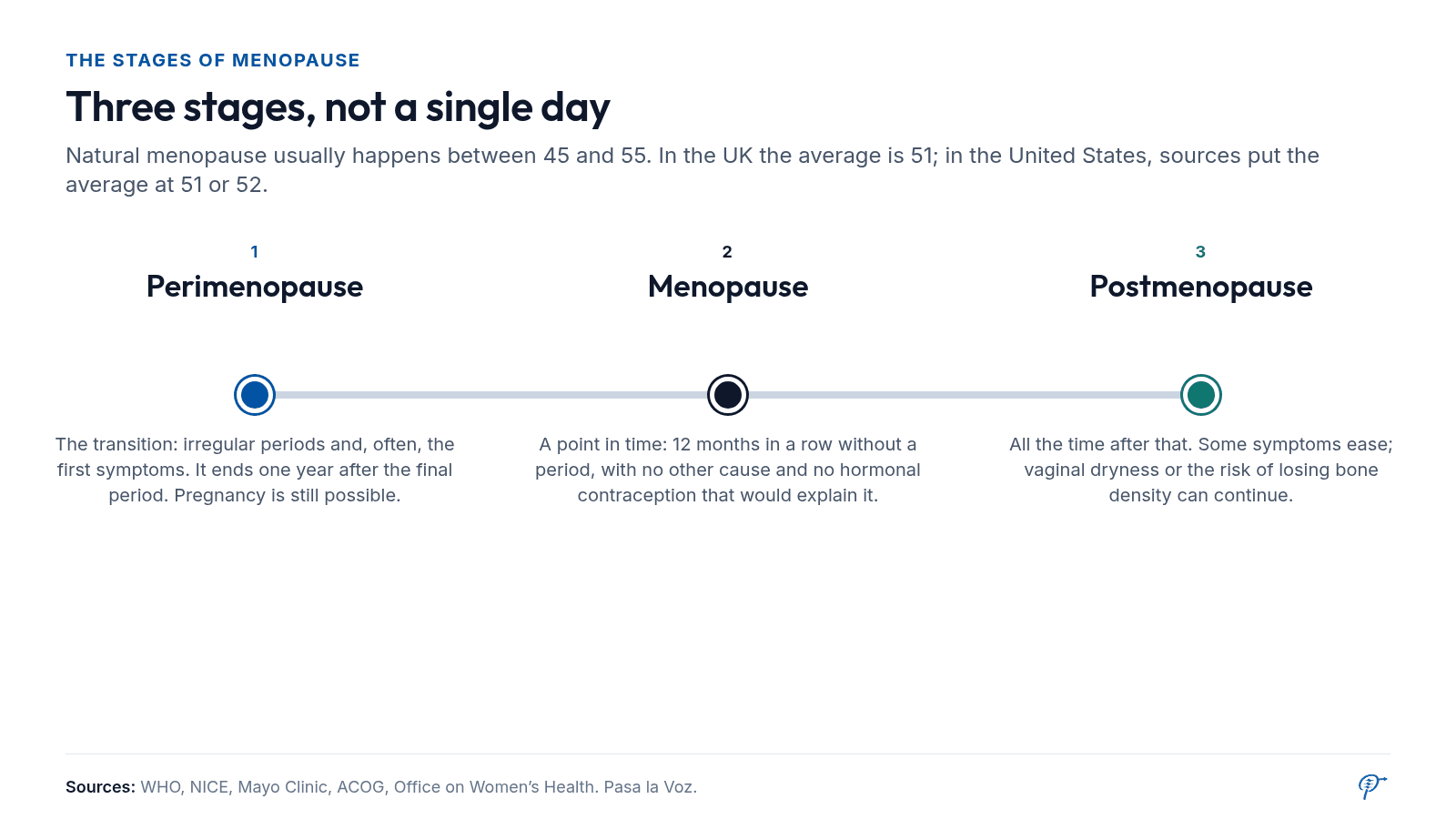
Menopause marks the end of the reproductive years. According to the World Health Organization (WHO), it is caused by the loss of ovarian follicular function and a fall in circulating oestrogen: the ovaries stop releasing eggs regularly and, in time, periods cease. It does not happen overnight. What people often call “the menopause” is in fact a span of several years.
Perimenopause (also called the menopausal transition, or the climacteric) is the period when hormonal and cycle changes begin. According to the WHO, it ends one year after the final period. Periods often come closer together or further apart, and bleeding may become heavier or lighter. Hot flushes, sleep problems or mood changes often appear already. Ovulation can still occur, so pregnancy is still possible.
Menopause is a point in time, not a long stage: it is diagnosed after 12 months in a row without a period, with no other obvious cause and no clinical intervention that would explain it. NICE, which writes clinical guidelines for the NHS, adds that hormonal contraception can change or stop periods, so that 12-month count does not work in the same way. In practice, a woman does not know she has reached menopause until that year has passed. Postmenopause is all the time after that. Some symptoms ease; others, such as vaginal dryness or the risk of losing bone density, can continue or become more pronounced.
Menopause can also come earlier if both ovaries are removed, or if a treatment (for example chemotherapy or radiotherapy) stops ovarian function. In those cases symptoms can start more abruptly, because hormone levels fall all at once, Mayo Clinic explains. If the womb is removed but the ovaries are left in place, periods stop, but hormonal menopause need not be immediate.
At what age it happens
The WHO places natural menopause, in general, between 45 and 55 worldwide. The exact age for any one woman cannot be predicted.
In the UK, the mean age of natural menopause is 51, and it can vary between ethnic groups. In the United States, Mayo Clinic and American College of Obstetricians and Gynecologists (ACOG) put the average at 51; the US government’s Office on Women’s Health , updated in October 2026, puts it at 52. The difference is small: what matters is the usual range. In Latin America, a 2006 study in 15 countries, with more than 17,000 women in 47 cities, found a median age of 48.6 years, with a wide range between cities (from 43.8 to 53). It is a useful reference, though it is now two decades old.
Sometimes it happens earlier. Early menopause is when ovarian function stops between 40 and 45, and premature ovarian insufficiency (or premature menopause) is when it happens before 40. Older analyses often cited about 1% of women (one in 100) before 40; more recent reviews, summarised by NICE, put the global figure at around 2-4%, and estimate that 7.6% of women in high-income countries reach menopause between 40 and 44. If symptoms start before 45, it is worth seeing a doctor promptly: tests may be needed, and treatment can be considered to protect, among other things, the bones.
What happens to the hormones, and which symptoms are common
In perimenopause the ovaries do not “switch off” overnight. They produce oestrogen and progesterone unevenly: the ups and downs can be harder to live with than the lower, more stable level afterwards. Those changes, the WHO says, can affect physical, emotional, mental and social wellbeing. Not every woman has the same symptoms, or the same intensity.
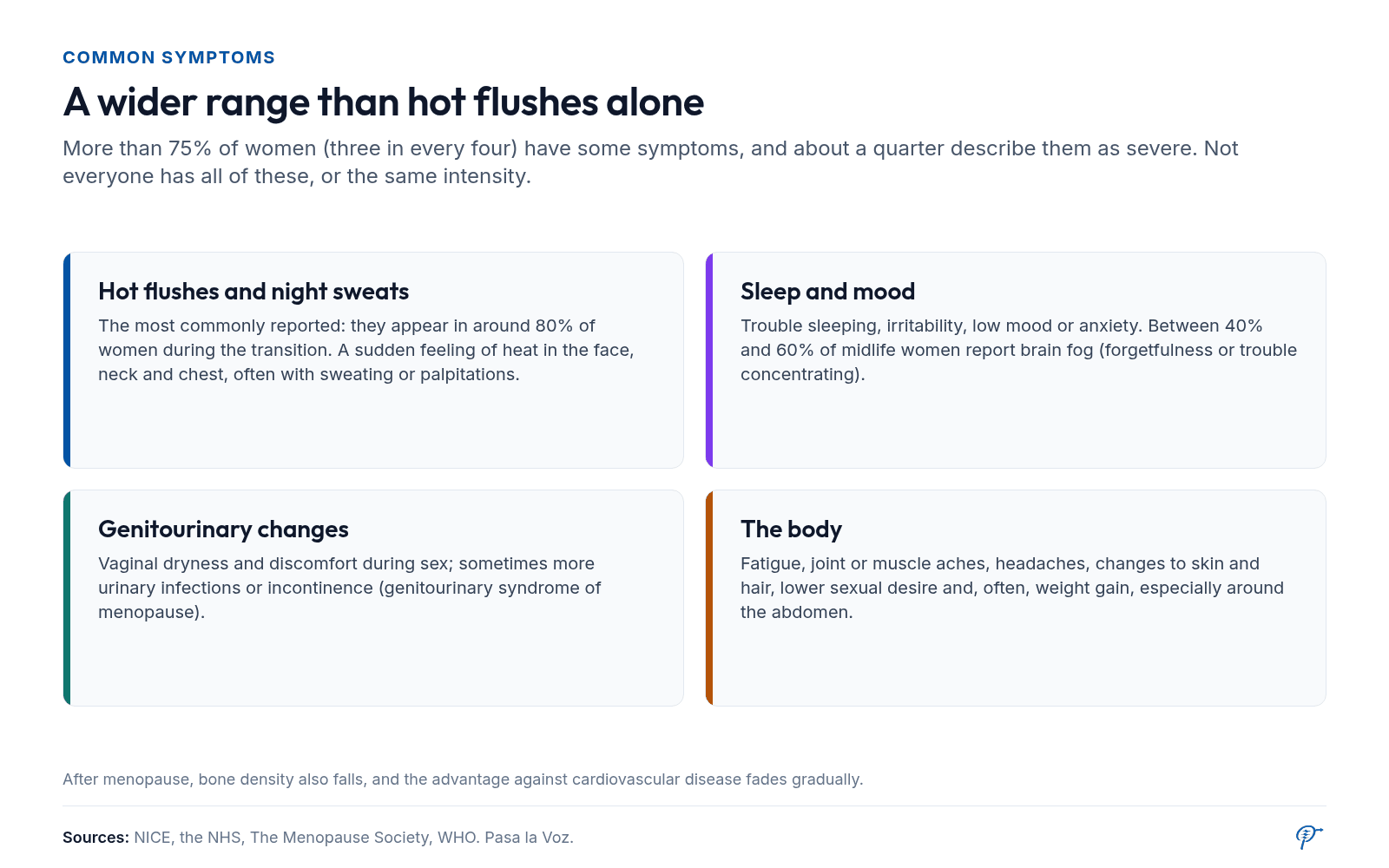
According to NICE, more than 75% of women (three in every four) have menopausal symptoms, and about 25% (one in four) describe them as severe. Hot flushes and night sweats appear in around 80% of women during the transition. The NHS and the WHO describe a wider range: a sudden feeling of heat in the face, neck and chest, often with sweating or palpitations; changes to periods; sleep problems; irritability, low mood or anxiety; brain fog (forgetfulness or trouble concentrating); vaginal dryness and discomfort during sex, sometimes with more urinary infections; fatigue; joint or muscle aches; headaches; changes to skin and hair; lower sexual desire; and, often, weight gain, especially around the abdomen.
The Menopause Society (formerly NAMS) says that 40% to 60% of midlife women report cognitive symptoms such as forgetfulness. These are usually mild and are not, on their own, a sign of dementia. Ethnic background can also play a part: the NHS notes that women from a Black ethnic background are more likely to have hot flushes that are severe and last longer.
After menopause, bone density falls and the risk of osteoporosis and fractures rises. The advantage that oestrogen had offered against cardiovascular disease also fades gradually. That is why this stage is a good time to look after diet, movement and medical follow-up, not only to “put up with the flushes”.
How long symptoms last
Duration varies, and not every symptom follows the same timetable. The NHS says symptoms usually last 7 to 9 years, sometimes longer, and that they can change during that time. Vaginal dryness and joint pain can continue after menopause.
For frequent hot flushes and night sweats, the most widely cited reference is the SWAN study, published in 2015. Among women who had them frequently, the median total duration was 7.4 years, and 4.5 years after the final period. In those who first had frequent flushes before the transition or in early perimenopause, the median was more than 11.8 years. The Menopause Society repeats the 7.4-year figure in its 2022 hormone therapy position statement. For a partner, that matters: patience is not a matter of waiting a couple of months, but of accompanying a stretch that can last several years.
When to see a doctor
There is no need to wait until symptoms are unbearable, or until 12 months have passed without a period, before asking for advice. The NHS recommends speaking to a doctor if you think there are symptoms and you want to know the options; if there are palpitations; if bleeding becomes heavier rather than lighter; or if, after 12 months or more without a period, there is any vaginal bleeding. That bleeding after menopause is usually not serious, but it should be checked, because in some cases it can be a sign of cancer, which is easier to treat if it is found early.
From the age of 45, in an otherwise healthy person, the diagnosis is usually based on age, symptoms and cycle changes, without a routine hormone blood test, according to NICE. Before 45, and especially before 40, a follicle-stimulating hormone (FSH) test may be useful. Pregnancy is still possible during perimenopause: the WHO recommends contraception until 12 consecutive months have passed without a period. The NHS is more specific in the UK: one year after the final period if the woman is 50 or over, and two years if she is aged 40 to 49. Hormone therapy is not a contraceptive.
What treatments exist (this is not medical advice)
There are options, and the decision is individual. A doctor can explain benefits and risks. What follows is a general picture, not a treatment recommendation.
Hormone therapy (also called hormone replacement therapy, HRT, or menopausal hormone therapy, MHT) replaces oestrogen and, if the woman still has a womb, a progestogen to protect the lining of the uterus. The NHS, ACOG and The Menopause Society agree that it is the most effective treatment for hot flushes and night sweats, that it also helps with vaginal dryness, and that it can protect bones. It can be taken as tablets, patches, gel or spray; for vaginal dryness there is also low-dose local oestrogen. The Menopause Society notes that, for women under 60 or within 10 years of the start of menopause, and with no contraindications, the balance is usually favourable for treating bothersome flushes; it is less favourable if treatment starts later or after 60. There are situations in which it may not be suitable, for example certain histories of cancer or blood clots: a clinician has to judge that.
Non-hormonal options include cognitive behavioural therapy (CBT), which the NHS and NICE consider useful for mood, sleep and also for hot flushes; vaginal moisturisers and lubricants; and some non-hormonal medicines when hormone therapy is unsuitable, not tolerated or not wanted. In 2026, NICE recommended fezolinetant for moderate to severe hot flushes in those circumstances; availability varies by country. There is little solid evidence, and possible interactions, for many herbal products sold for menopause: the NHS advises speaking to a doctor before taking them. Lifestyle measures do not replace treatment when symptoms are severe, but they do help: regular activity (including weight-bearing exercise, for the bones), a diet with enough calcium, not smoking, limiting alcohol, a cool bedroom and light clothing.
How a partner can help
NICE recommends that information about menopause also be shared, where appropriate, with the family. You do not need to be a doctor to be a good partner. This applies whether you are a husband, a wife or any other partner. The practical guidance follows the recommendations of the NHS.
Learn about it. Reading about the stages and the options, from reliable sources, helps avoid two common mistakes: thinking “it’s only hot flushes”, or assuming it will be over in a few weeks. Understanding that there is a hormonal basis does not mean excusing any behaviour, but it does stop everything being read as a problem of character or of the relationship.
Listen and validate, without trying to fix everything. What often helps most is not an instant solution, but your partner feeling believed. Phrases that play it down (“it can’t be that bad”, “every woman goes through this”) tend to shut the conversation. Asking “what would help right now?” is usually more useful than listing remedies.
Practical help at home and with the environment. Tiredness and night sweats take a toll on both of you. The NHS leaflet for partners suggests a cooler bedroom, separate duvets (a lighter one for your partner) or, on some nights, sleeping apart so that both of you can rest. It also helps to take on more chores in the harder stretches, and not to pack the weekend with plans.
Encourage medical advice, and offer to go along. Encouraging your partner to book an appointment, offering to go along, and, if she wants, helping to note symptoms and questions, can make a real difference. Any decision about treatment is hers. A partner’s role is to help her reach a professional, not to push for or against hormone therapy.
Patience and empathy, without taking it personally. Hormones and lack of sleep can make reactions sharper than usual. That does not turn a partner into a punchbag, nor does it mean accepting disrespectful treatment. It does mean not reading every bad moment as a rejection.
A team approach to intimacy and daily life. Vaginal dryness, pain during sex and lower sexual desire are common and have physical causes, not just “a lack of interest”. Pressing the issue, or taking it as a slight, often makes things worse. It helps to talk calmly, use lubricants or moisturisers (if you use condoms, choose a water-based lubricant) and, if needed, for your partner to ask about options such as vaginal oestrogen. Intimacy can also, for a time, take other forms of closeness.
A practical checklist
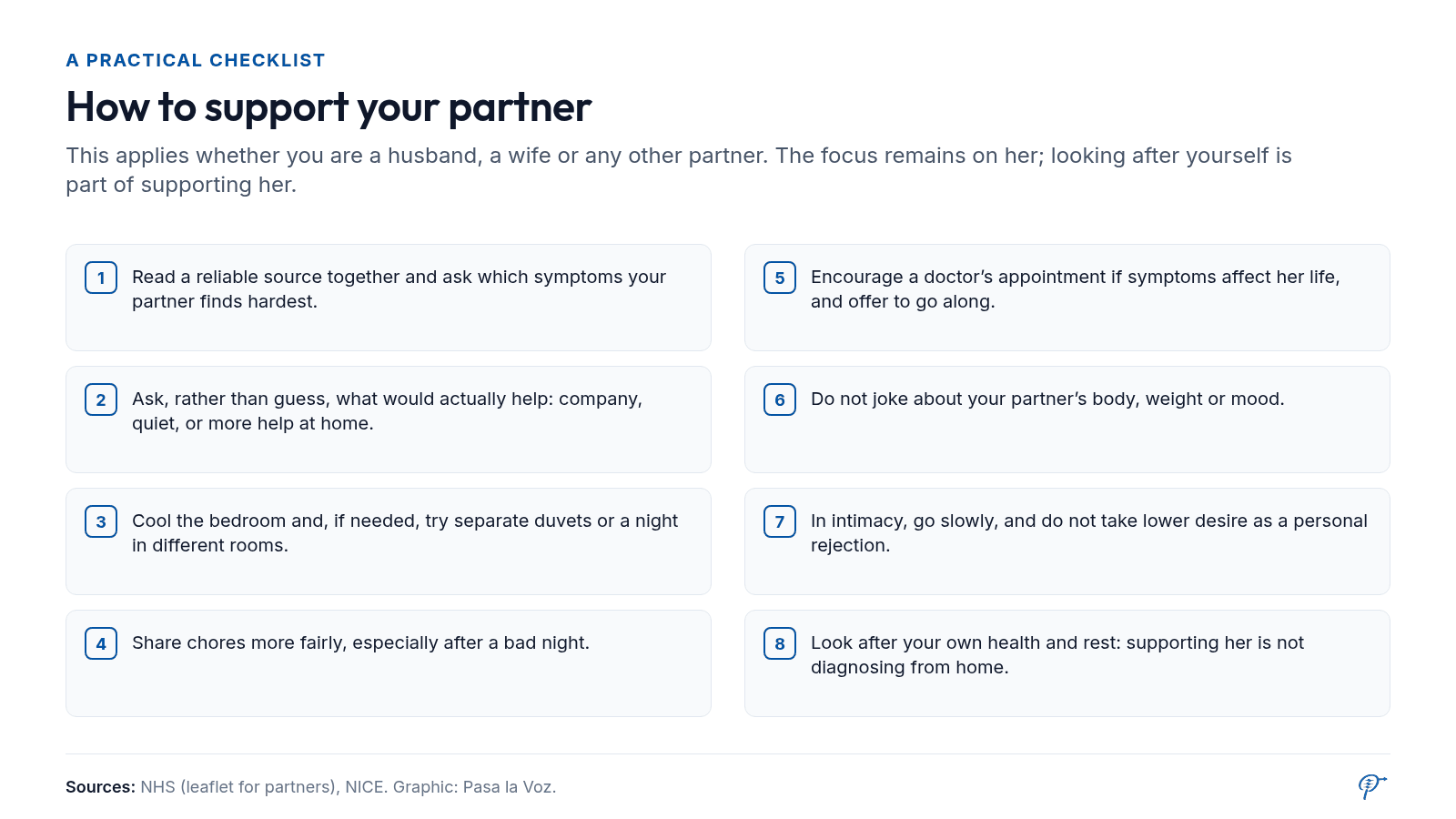
- Read a reliable source together (for example the WHO or NHS pages) and ask which symptoms your partner finds hardest.
- Ask, rather than guess, what would actually help: company, quiet, fewer plans, or more help at home.
- Cool the bedroom and, if night sweats are wrecking sleep, try separate duvets or the occasional night in different rooms.
- Share chores more fairly, especially after a bad night.
- Encourage your partner to see a doctor if symptoms are affecting her life, if bleeding becomes heavier, or if there is any bleeding after 12 months without a period. Offer to go along.
- Do not joke about your partner’s body, weight or mood.
- In intimacy, go slowly, talk about what hurts or feels uncomfortable, and do not take lower desire as a personal rejection.
- Look after your own health and rest as well: supporting your partner is not the same as diagnosing from home.
Partners need support too
The focus of this article is the woman going through menopause. That does not mean her partner is untouched. Sleep broken night after night, changes in mood or intimacy, and the feeling of not knowing how to help can leave anyone confused, rejected, stressed or simply tired. That is a normal reaction, whether you are a husband, a wife or any other partner. Looking after yourself is not a distraction from supporting her: it is part of it. A worn-out companion helps no one.
Talk to someone you trust: a friend, a family member, or someone who has been through a similar stage. Keep to reliable information, such as the NHS, NICE or Menopause Matters. If the strain starts to weigh on you, speak to a doctor, or consider counselling, including couples counselling (in the UK, Relate is one option). And, as this article has already said, try not to take the symptoms personally: they have a hormonal basis, and they are not a verdict on the relationship.
Menopause is an ordinary life transition, not a flaw that has to be “corrected” in silence. With information, patience and a little organisation at home, a partner can be an ally in years that are better faced as a team.
Sources
- World Health Organization: Menopause (fact sheet), 16 October 2024
- NHS: What are menopause and perimenopause?, Symptoms, Treatment and Things you can do, last reviewed 19 May 2026
- NICE guideline NG23: Menopause: identification and management, last updated 15 April 2026
- NICE CKS: Definition and Prevalence
- Mayo Clinic: Menopause: symptoms and causes, 9 July 2026
- ACOG: The Menopause Years, last reviewed December 2025
- Office on Women’s Health (US): Menopause basics, 19 October 2026
- The Menopause Society (formerly NAMS): Perimenopause and 2022 hormone therapy position statement
- Avis, Crawford, Greendale et al.: Duration of Menopausal Vasomotor Symptoms Over the Menopause Transition, JAMA Internal Medicine, 2015 (SWAN study)
- Blümel et al.: Age at menopause in Latin America, Menopause, 2006
- NHS England: Menopause for partners, 6 January 2020
- NICE: Fezolinetant for treating moderate to severe vasomotor symptoms associated with menopause (TA1143), 2026
- Menopause Matters: website, founded by gynaecologist Heather Currie, a past chair of the British Menopause Society
- Relate: Menopause, relationship counselling in the UK